

With 18 years in business and 12+ trucks on the road, Morgan Miller Plumbing is no stranger to industry success. It was in 2011 that they realized it was time to up their Internet marketing game and bring someone on board that would help generate a lot more business via digital advertising outlets like television, Pandora radio, banner ads, Yelp, and social media. That is when Morgan Miller Plumbing hired rock star Tosha Everhart to run their campaigns.
Since 2012 Morgan Miller Plumbing has increased their revenue from $1.7 Million to almost $2.7 million in 2015 and aside from their excellent work record they have attributed a lot of their success to social media and community networking.
Morgan Miller Plumbing has taken some risky but ingenious steps on Facebook setting the mold for what other companies should be doing but are too afraid to try and the results have been significant. Through Facebook advertising they have seen a 39X Return on Investment and are now hiring almost all of their new technicians via Facebook marketing. They've done so well in fact that they were featured on Facebook Business as a marketing success case study. Morgan Miller Plumbing has its own personality and that is exactly what they like to highlight on social media. People get a great understanding of who they are as people and as a company and everyone seems to love what they see.
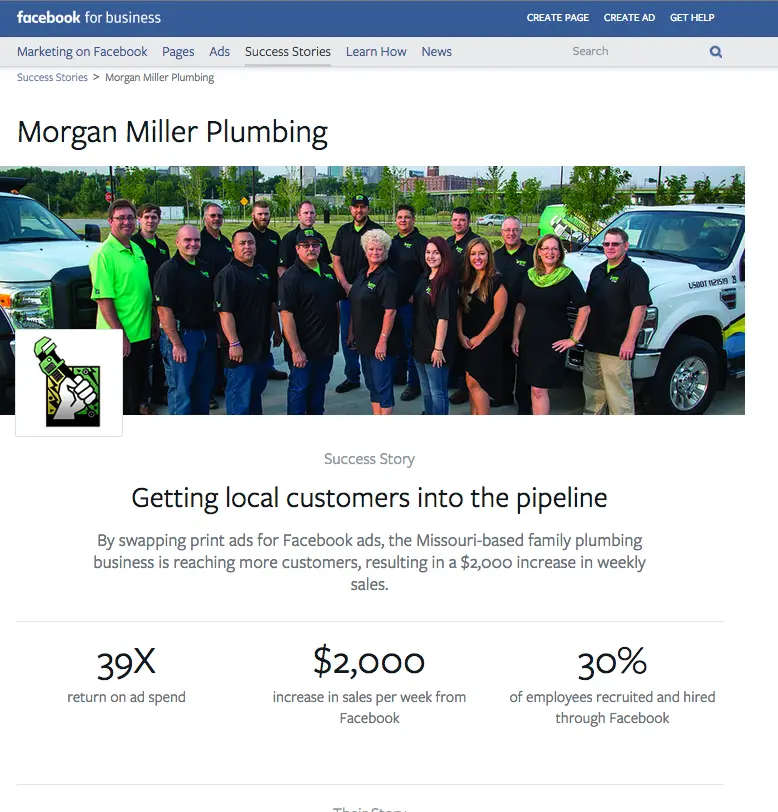
Morgan Miller Plumbing was even handpicked by Facebook to be one of twelve small businesses to personally visit their headquarters in Palo Alto as part of their involvement with the Small Business Council. They have the inside scoop on what's working and share it with you here.
Watch the interview now:
You won't want to miss this interview. It is chalk full of great information. Please post your comments & follow up questions below!
Be sure to check them out online, review their Facebook Page and model their success:
- Morgan Miller Plumbing Website - http://www.morganmillerplumbing.com/
- Morgan Miller Plumbing Facebook Page - https://www.facebook.com/MorganMillerKC
Also, be sure to subscribe for the podcast so you don’t miss any of the upcoming interviews. To subscribe via email click here or to subscribe via iTunes click here.
If you would like to talk with us about your Marketing Strategy
and how we can work together to take your
Plumbing or HVAC Company to the next level . . .
Give us a call at 866-610-4647
OR
Click HERE to schedule a time to talk.
Plumbing Marketing Interview ‑ Morgan Miller Plumbing
Announcer: The Plumbing Marketing Profits Podcast. Interviews with million dollar plus plumbing and HVAC business owners on how they market and grow their companies in today's economy. Hear directly from the most successful leaders in your business, and discover what they are doing to keep their phone ringing, trucks running, and businesses booming.
With your host, Josh Nelson.
Josh Nelson: Well hey everybody, this is Josh Nelson with The Plumbing Marketing Profits Podcast, and I'm really excited to be able to interview Jeff Morgan and Tosha Everhart of Morgan Miller Plumbing.
They've done some amazing things with the growth and advancement of their company. They were recently featured on Facebook Business' case studies as a company that's just rocking it with Facebook advertising. When I saw that I knew I had to do whatever it took to get an interview scheduled and set up with these guys.
I'm very excited to introduce to the call, Jeff Morgan, who's the owner and president of Morgan Miller Plumbing, and Tosha Everhart, who's the marketing director. Thank you guys so much for joining us.
Jeff Miller: You're welcome. It's an honor.
Tosha Everhart: Thank you for having us.
Josh: Absolutely. I've also got on the call, Steve and Michelle, who are part of our team, but they also run The Social Plunge Podcast, which you may have heard online on iTunes. It really talks about leveraging social media within your plumbing, or HAVC business. Say hi, Steve and Michelle.
Steve: Hallo.
Michelle: Hallo.
Jeff: [laughs]
Josh: Let's go ahead and dive right in, and learn a little bit more about Morgan Miller Plumbing, and get some of the background. If you guys don't mind, tell us a little bit about the company, the demographics, how long you've been in business, number of trucks, that type of thing.
Jeff: We've been in business 18 years. We've got 12 service vans on the road, and that is growing daily it seems.
Josh: Wow.
Jeff: Thank you. We're a residential and commercial service, and emergency repair company.
Tosha: We got a new construction.
Jeff: The new construction is not something that we do. We don't even do a lot of remodel work anymore. Mainly our revenue is from service, and emergency repair. Our revenue for 2015, is projected to be somewhere in the 2.5 to 2.75 million. Last month, we had our biggest month since our history. We did right at 300,000.
Josh: Wow. Congratulations. It's so exciting to be part of a vibrant growing business, huh?
Jeff: Yeah. [laughs]
Tosha: Thank you. It's exciting, and stressful, and sad, and a lot of emotions all at once. [laughs]
Josh: To give us a sense of the growth. I know that there's been a consistent growth over the years. Sounds like there's a velocity point, where you guys started to see greater growth than ever. At what point do you feel like that shift took place where things started to accelerate a little bit?
Jeff: 2012, 2013 is when we really started to start to have to hang on. The last two‑and‑a‑half to three years.
Josh: OK. If we look back at 2011, what do you think your approximate revenue was at that point?
Jeff: 1.7, 1.8.
Josh: Wow, OK. You've gone up by about a million dollars just over the last couple years in revenue, which is phenomenal.
Jeff: Thank you.
Josh: There's two ways to go about growth. There are certain companies that you hear about that they get aggressive with market. They grow, but they didn't have the people. They didn't have the systems. It winds up hurting them as opposed to you guys had a long enough history that it sounds like you really had the right people and the right systems in place to manage that level of growth.
Jeff: We've had our ups and downs, Josh, over the last 18 years certainly. We used to do a lot of new construction. That burned us even before 2008, which was the year that everything started falling around the country. We certainly punted, took a look at what we were doing, and now we're all about the hiring.
That is difficult. It's hard to find the people that fit our model. We're not easy to work for. We like that, but we do have a lot of fun. There's just certain people that fit our lifestyle. I don't know if I'm explaining that.
Tosha: Our company culture more or less.
Jeff: Yeah.
Josh: Since we're on the topic, what are some of the aspects of the Morgan Miller culture?
Jeff: It can't be about yourself. It's always got to be about our vendors, our customers, and our associates. We're looking for men and women that are career‑oriented instead of, "I just want a job." They seem to want to invest more of themselves in the company that way. We find those people. If they don't fit, we don't really let them stay very long.
Tosha: We're very big on transparency. For transparency it's a big umbrella. I mean the transparency of your family, the loyalty, the motivation, the personality aspects in general. Transparency is something and being very empathetic are two of our very huge umbrellas.
We need to see that you project those things for us because the founding people who have been here, have built this, and are running it now, we all show that. We can pretty much determine, within your first 90 days, if you have those characteristics that we are looking for. We will know in your attitude and there are things we hear from customers to follow up and everything of that nature.
Jeff: That's really a big part of the success of the company outside of just marketing is getting the right people on board and knowing what you are about and the type of person that you need to get so that you can continue to not just grow the company, but provide exceptional service and have some sustainability to what you are doing.
Jeff: We've learned the hard way, we can only charge as much as our service is good. Our service is only as good as the weakest link on the team.
Jeff: As we talk with successful plumbing and HVAC contractors across the country, that is one of the biggest challenges that these companies are facing. As they grow, they know that they can provide the service, but getting good technicians, getting them trained and making sure that they are providing the type of service that the company was built on is a major challenge.
I know you guys have some cool things that you are doing with Facebook advertising to attract, and I'm excited to talk about that a little bit later in the interview, because I know that that is something that just about all of our listeners are going to be excited to learn more about.
Jeff: That has been phenomenal. I'd love to expand on that later on.
Jeff: Beautiful. Actually, before I dive into the next section, at what point did Tosha enter the company as the marketing director and really help you guys? Tell me a little bit about Tosha's role within the company.
Tosha: [laughs]
Jeff: She started four years ago in October. I had already delved into social media two years prior to that. My son was assisting me who is about the same age as Tosha. She's in her mid‑20's now. I don't know if I should have broadcasted that online. I'll have to live with that.
Tosha: It makes me sound younger, so that's fine.
Jeff: I already had quite a monster on my hands. I knew I needed some help. We found Tosha through a friend of ours, her mother. She was in school at the time, in college, at a local University here in Kansas City. She was graduating with a communications major. This was perfect for her.
She started working for us part‑time, but it was really full‑time. She was going to school full‑time. Tosha came in here and she was a real whirlwind. She's got the energy of two or three of us. The minute we hired Tosha, I knew it was a good hire because everybody around me said I was nuts.
I knew what I needed. They didn't. You know what I mean? She came in and she instantly made us cool.
Tosha: [laughs]
Jeff: I'm sure a lot of the people listening to this would love to know how they can find that Tosha‑like person. I know that she is a diamond in the rough, but any specific insights on how you attracted her and what the job description looked like on the front end? Did she come in as marketing or did she come in as something different?
Jeff: No. She came in as our marketing director. It took some time for us to learn what she could do and what we needed exactly. I just started asking people. Her mother, I got lucky. Her mother cut my hair for 35 years. I am sitting there in the chair and I jokingly said, "You know, I am so busy. I have so many meetings. I almost need a publicist." I was just joking around.
Her mother hit me in the arm and said, "Well, you're going to hire my daughter Tosha." I said, "I am?" She said, "You are." I did. [inaudible 09:56] . We were just talking. I was just talking to people and expressing what I needed. Now, we do that through social media and typically it comes to me.
We just hired a dispatcher two weeks ago. We didn't spend a dime. We put it out there on Facebook and had five excellent applications. Turned that into two wonderful interviews. The gal has been with us almost a month and I can tell she is going to fit real well.
Jeff: Nice. Nice. We'll dive into that even more as we go. Every time I do these interviews, I like to talk about the four M's of the marketing triangle, which is message, market and media. Before you can have an effective marketing strategy for your plumbing on HVAC companies, you have to be very clear about your market.
That's the "who" that you are selling to. Really what the avatar for that person is and what their unique characteristics are. I'm sure you guys have spent a lot of time thinking about that ideal target market. Just tell me a little bit about you guys' avatar in your particular market and who you're really selling to as a company.
Jeff: Who we're selling to is the home owner ,andhe business owner and the property management company. That's who we're trying to attract.
Tosha I know that's a big oversight but when we produce our messages, we have specific...what's the word I want to use? We have certain setups of different types of ideal customers. The newlyweds who just bought a brand new home and your first time home owners, we have the retirees who are wanting to make their home more handicap accessible, easier to, as you get older, walk and shower.
People who have the money and who want to progress their home as they progress. We've got singles, can't forget about those singles out there, who have just bought a home as well. It's hard to just answer that, we don't have one set ideal customer. We have different scenarios of ideal customers for us.
Josh: You got to cater your messaging to those different groups. Maybe the elderly, the newlyweds, the recently moved in singles, et cetera.
Tosha: Yes.
Josh: Got it. Beautiful. The next piece is the message. When you're clear on who you're selling to, it's really about, how do you position yourself differently in the market place, which makes you more attractive to that particular audience. What kind of messaging are you using and how are you positioning yourself uniquely in your service area?
Tosha: I hate to be so political, but there's two different sort of messages that we'll send. We'll send a social message and we'll send more of our media message. Our media message, we want to focus more on our values and who we are as a whole and the overall. The social we loosen up a bit and we're very transparent.
Again, going back to the transparency, it's something that we've instilled and we constantly will message to everyone is, we are who we say we are. The people that we post on media and social are the guys that will show up at your house, and that's a lot of interaction that we'll give when we focus on, say, a spotlight on a service technician, something of that nature.
A lot of the engagement we get is, Suzie Homemaker has said, "James has come to our house. I love Chuck, he's wonderful." We are who we say we are, we're your trusted advisers. We're not selling you stuff you don't need because of the values and everything that we instill before the message needs to even go out.
Josh: For you guys the transparency and authenticity is key to your messaging. It's, well, these are the real people, this isn't a stock photo, this is the real guy, this is his back story.
Tosha: Absolutely.
Josh: It resonates with customers, that that guy actually shows up at their front door.
Tosha: Because being a service company, automatically no matter what, we have a horrible stigma and reputation that it's not going to go away. Slimy, scary, untrustworthy, we've faced it.
Jeff: Dirty, smelly, stinking.
Tosha: Yeah. I could go on for days of all the things we've heard. Why not just show who we are upfront and we're not lying when we say, "Here is the uniform. Here is the van. Here is the guy. Here is who we really are. Get to know us before you need us and we'll be there."
Josh: I love that. That really leads us to the part that everybody likes to think about when they think marketing, which is the media. There is all of these different channels, from direct mail, to social media, to email marketing, to Internet and Pay‑per‑click.
What type of media mix do you guys leverage to generate new leads within the business?
Tosha: We have your television media. We have radio, but we're not doing radio in the traditional sense. We're on Pandora, because that's just where it's all going, seemingly. We've got our online advertisement, so we've directed and targeted local websites and they're working through that, where we'll be on banner ads.
Again, we've served them up to the certain target audience that we're talking to. It's not necessarily media but your network, like you've put on here. It's really important to never forget the face to face stuff, it's just as important, and now, as of today, people really focus on it.
They forget about how nice it was to receive a thank you letter, because people don't get those anymore. Or a handshake. Or remembering someone's name even. It's huge and it goes a long way.
Josh: No doubt.
Jeff: Josh, we belong to 16 different organizations. When we started snowballing that little train we figured out that, you know what? There are several key employees or associates that work here that have passion. That are involved in different organizations already.
Maybe Morgan Miller Plumbing can help them be more involved in that organization, and they can attend the meetings once a month, once every other week. They get to leave the shop for three and a half to four hours and go do something completely different, and get compensated for it, but they're out meeting the people.
There's no way that I could go to 16 different functions every month. It's really cool, so we started letting all the key associates here at Morgan Miller Plumbing participate in our networking that made them invest in the company more.
It gave them a change of scenery, they gave them a sense of being very connected to the company. They get to go have fun every now and again, because most of the networking things, if you do it right, it is fun. Have a lot of free lunches and the evening ones you get to have a beer sometimes. It's a great way to network.
You know what they say, when you start going to these meetings they will come to us and they will say, "You know what? I saw your post yesterday. I saw your post last week. How's your daughter? I saw that out on your Facebook." That's when you don't work, [inaudible 17:32] do about it."
We only direct mail to our existing customers and we send out postcards four times a year.
Tosha: We don't blank it. We did, but no.
Jeff: Yeah, just to touch base with our existing customers. Just to let them know that we're still here. [inaudible 17:53] for being our customer.
Tosha: Yelp is also huge with our industry. We get a 10 to 1 return on Yelp almost every single month.
Josh: Your paid advertisements on Yelp? The premium listing?
Tosha: Yep.
Jeff: Tosha said to me four years ago, we need to go into here, and I didn't know the word Yelp, what it meant.
[laughter]
Jeff: [inaudible 18:19] . That's what I meant about her instantly making us cool.
[laughter]
Jeff: She knows a lot of the other stuff, and in fact our marketing company was doing our TV commercials and helping us set with the Pandora ads and stuff, they're pretty young also, and so they know all that stuff.
When we first started getting on to Facebook I wanted to connect...this was six and a half years ago Josh. I'm thinking how powerful this tool is, if I can connect with the kids that are on here, 20 to 30 years old, in 5 to 10 years when they're 30 and 40 years old and they own the world, they will already know us. That was my first thought about social media.
Josh: Plant those seeds early, right?
Jeff: Yeah. What happened along the way is everybody at my age ‑‑ I'm 55 next month, thank you ‑‑ along the way everybody at my age got plugged in. We were already established, we're already plugged in, we're already going and then we attracted this whole other level and thickness of potential customers because we're already there.
Josh: I definitely want to dive...
[crosstalk]
Jeff: ...people, but it doesn't matter if you've been on for six and half years like us or if you just started like next week, there's going to be an update tomorrow, so everything is going to change.
Josh: I definitely want to dive deeper into the Facebook specifics, because I think that's a critical crocks of it. One of the cool things that you're telling me is, you guys have a very diverse marketing mix and a very diverse marketing strategy. For the listeners, the companies that're doing the best are not doing one thing. They're not just doing Internet marketing. They're not just doing Facebook. They're not just doing radio.
They have a diverse mix that really helps them to start to dominate and be the top of mind leader in their market place. You guys are doing TV, radio, online ads, on banner advertising, local networking, which I think is huge and most plumbing HVAC companies just aren't involved in their local community at all. You're direct mailing your existing customer base to drive that repeated or referral activity.
Obviously, you are active with social media and online directories. If you had to look at that overall mix, if you're trying to say what drives the most in terms of net new lead flow, what would you say is your number one channel?
Tosha: It's hard. I would say online social and networking are, and I'm sorry. It's not just one but it's really hard to pick. I'd say the real life networking and online flash social. Anything that really we've done in our social, I even consider Yelp kind of social, that world for me. Those have been probably our biggest revenue, one specifically, if I had to pick.
Josh: Awesome.
Tosha: Any clues on...?
Jeff: No Facebook is the mothership.
Tosha: Yeah, that's why it's a social, yeah.
Josh: Yeah, social falls directly into that. That's awesome. You guys are definitely on the leading edge of...Though leveraging those platforms to drive revenue, if I talk to 10 plumbing or HVAC business owners, 9 of them would say, "Ah, social media, I spent a lot of money," or "I did some social poster and nothing happened."
Obviously you're doing something different, and that's what I'm excited to dive into deeper. But before we go there, I know we only have a limited amount of time, but I definitely do want to touch you on the TV and radio strategy. What type of message are you putting out on those ads and on those radio ads? What kind of messaging is that? Is it just one centralized add, "Hey, if you need a pluming company we're your guys," or what are those adds messaging?
Jeff: On the TV add, we're seasonal on that, typically in the winter we'll do water heaters. In the summer we'll be drain work and our TV ads up to this day has been pretty serious. My wife say, "Don't embarrass me." We don't try to oversell.
Tosha: Or we really don't sell at all. TV is more of a awareness, top of mind, remind you of who we are. We have a little called an action in there, but again it focus more on who we are overall than, "Call us we're great," "Oh is your garbage disposal clogged, we'll help." It's more of, "Hey, we're here if you need us," very subtle.
Josh: Are you running that on the same channels, pretty much again and again in order to hit that same audience? Or what's your network [inaudible 23:23] strategy?
Tosha: We hit a couple different stations. I think right now it might be two and we're hitting different times during the day. The one that will go live in August with, we're actually going to switch up the time, so it's kind of a beta test if what do you do, and what kind of audience we get a feedback on with those. But generally they're going to be steady stations. We're adding one in August and again changing up the time, it's just a beta.
Josh: Beautiful stuff. I really like where you said about giving your team which has certain interests and certain passions and letting them be the ones to attend the networking events. It's not just the owner that has to hold that responsibility. We can get them all engaged.
It sounds like from your experience those team members enjoy getting out of their daily routine and being able to be part of the community, which gives them more pleasure in their job. But it also gives your company this greater footprint in the market place.
Jeff: It's just worked wonders and a lot of that just accident. You don't know how good it's going to work until you do it. But they like to say, "You got to change some things up," but everything's changing and you can't just sit here. You got to move.
Tosha: It helps connect the guys who are actually on the field with the people who are in office all day. Because at times in these service companies there is a line. There is people who think that the people in the office may just kind of hang out, eat, eat is the way to, what's the word I'm thinking of kind of? Merge and mash up all together as one.
Because the people and the techs who are out there doing the plumbing, go to these networking events they'll then come in and they'll say and be like, "How do you guys do this all the time?" "That was not easy. I enjoyed it" But it's a way, its kind a connect us in, merge us all as a company and a whole team together.
Josh: Right, I like that. It kind of brings down some of the barriers where they're getting to get inside in sides of the company they would have never seen otherwise.
Tosha: Exactly.
Jeff: Then we get to go as special guest stars when they have their big events. That makes me feel like a big shot, my boss to be with.
Josh: The rock star treatment.
Tosha: Yeah.
Josh: I think the diversification that you guys have is critical to the success. Now I really want to talk really a little bit of depth about, the specifically the Facebook advertising. Because, again, your company a once featured on Facebook for Business as the case study, and talked about a 39 time return on investment, $2,000 a weak in additional sales.
Something that I am really excited about, because I know that the listeners are going to want it to like a year about is, I'm recruiting almost 30 percent of your new talent through Facebook and that's...
[crosstalk] .
Jeff: Most of night birds are all pretty old, Josh.
Josh: Yeah.
Tosha: Probably more now.
Josh: They're outdated. You guys are even compatible in that now.
Jeff: That was March of 2014. That probably was published in April or May that year. Tosha and I were invited to face the headquarters.
Her and when my son worked here they asked me to go on read blogs about customer service and plumbing, and make comments about them as Morgan Miller Plumbing, and you'll help our SEO. In other words, "Get out of our office," what they were saying. I made a comment about a blog who's written about the Vice President, Small Business for Facebook.
Dan Levy is his name, and it's still his job.
Tosha: Actually, he got promoted. He's like the overseer of it all.
Jeff: He's a beautiful man. Anyway, so I write this comment, and in real just about how Facebook can change our company, changed me and changed the perception I had of our company. Which by the way is what social media does, but we'll talk about that later. Dan calls us the next day and introduces himself and Tosha and I are dancing around...
[crosstalk]
Tosha: Once we realized that wasn't a fake call, and we weren't being like catfish or something.
Josh: This is really the guy, right?
Tosha: Yeah, like, "Oh my gosh, this is really him. It's not some person who is scamming us."
Jeff: We started talking every month on a conference call about, what we did this month? How's it going? What are we dealing? What can Facebook do? They let us do some testing for them behind the scene, on screens that weren't published yet. That was kind a cool and every time they call, I'd end the conversation with, "Dan, you know what, just invite us up Palo Alto someday. We can get a lot more done."
[inaudible 28:19] conference calls once a month. February 2014, he says, "And by the way, we're putting a small business council together, 12 different companies around the nation, and we want you to represent the home services company. And we want you to come up in March next month to our headquarters and have a chat."
Josh: That's awesome.
Josh: Then we build ourselves off the ceiling and we went out there. Talking to you, Josh, is a dream come true. I mean that. I've been following you for years.
Josh: Thank you, I appreciate that.
Jeff: To be able to sit here and look at big, giant mural of our beautiful city Missouri, and be talken to one of those leaders in our industry, all because of social media, just blows my mind.
Josh: Tell us little more about what happened in Palo Alto?
Jeff: We spent two days out there. We got meet Sheryl Sandberg, she is the COO of Facebook, self‑made billionaire. Everybody stop in their tracks when she walked in the room, talk about rock stars. I went up to her and asked her to shake her hands, because I never touched a billionaire.
Tosha: If you haven't noticed Josh is more of the...I have to keep him in line sometimes, and I borderline things, that's meant that's why I was hired four years ago.
[laughter]
Jeff: Before we are done, Sheryl's asking if we can pick some of her plumbing, and I told her we could be out here by morning without any problem.
Josh: Absolutely.
Jeff: Now for the last year and a half we belong to this small business council. We throw ideas to each other. We visit with each other. We have regular meetings, we talk about new stuff coming up.
Tosha: The actual summit, the two day summit, it was a way for them to pick our brains of different small business users of Facebook, of how can we either can do things better, capitalize on what we have and focus a little more on that, what irritations that we all focus on, and app.
Because some of the people that were there, they run different platforms. One person they have a restaurant and the other person has a jewelry auction site on Facebook. It was a way to pick 12 different types of businesses brains all at once.
Josh: Yeah. Listeners, you guys are hearing directly from pretty much as close to the source as you can get of people that have actually been to Facebook. They've gotten the inside information, and they've [inaudible 31:05] our strategies that even the numbers that I've up on the screen, it's exponentially better than that. I guess is what you're telling me now, right?
Jeff: Absolutely. Josh, we thought about doing something similar to what you're doing or to coach, or to teach, or do community based stuff. But it takes tenacity, and we haven't found too many that would just stick with it.
Crucial thing, you just can't say, "I did that for a month." You can't just sign the check and give it to somebody, that's not being social. We have not run the numbers for quite a some time. But I would say there are per week number, it's not 2500, probably close to $3,000 a week. Their recruiting is, every person that we hire is through Facebook now. We hire three men in June.
Tosha: And one woman.
Jeff: And one woman.
Tosha: Don't forget about the lady.
Jeff: Yeah, the lady. Each one of them came through Facebook. They studied our Facebook page, they've been following us for quite some time and liked what they see, and if we got any openings. When they see that we've got an ad running on Facebook for plumbers, that's when we get some really good calls.
Jeff: They jump right in.
Jeff: Men that are working, and women that already have jobs.
Tosha: Yup.
Jeff: Which, typically for us ‑‑ and I know, out there, the industry wide, they're talking to people who don't have work, who are out of a job, or who have been fired. That's not, typically, who stays here that long. The guys that we're attracting now already have pretty good jobs, they just want something nicer.
Jeff: You tapped in to the hidden gem, which is the very best technicians, the very best plumbers, are working somewhere.
Jeff: They've not viewed you a million times, they saw you, you probably posted about it.
Jeff: Yup. you guys are now leveraging Facebook to get to those guys that are working somewhere that are good, that aren't going to get fired, but just happened to be attracted to your culture because of the way you're positioning yourself in the, like you said, in the authenticity that you're projecting through social media, and you're networking, and industry involvement.
Jeff: It might be just one more time, that one time when the boss just treats them like they don't want to be treated, and they just got to make that change. Change is hard. I started this company 20 years ago because I didn't like the way I was being treated, or I'd still be there.
Jeff: Yeah, exactly. I guess when we talk about social media and, specifically, about Facebook, there's a couple of different aspects and a couple of different elements. There's the social part, which is how you set up your pictures on the profiles then the type of post that you're putting out. I think that's a critical part that I want to pick you guys' brain about.
The other part is, other than just posting updates, leveraging social and the paid platform, the paid advertising to attract likes and to attract business. Let's start with the first side of the equation, which is just how you guys are positioning yourself and the type of content that you found to be most effective in your posting strategy.
Tosha: For our posting strategy and for social in general, you don't want to make it about you. You can't make it about you, you can't make it that, "We're plumbers, call us, we're awesome, and so so so, bye bye bye." You have to make it a way of, "We're here, we're giving you this," and here you see a picture of a unicorn and a puppy and stuff like that.
We're making it about us but we're not. The key importance is that you're seeing the logo and name of our business 365 days a year. When you're subliminally seeing Morgan Miller Plumbing, but our post might not necessarily be about plumbing.
If you look through the history of our posting, it's maybe once every two weeks that we do post about plumbing...
Jeff: Tell him about yesterday's post.
Tosha: It's been really disgusting hot here, so hot, not still air. We thought a picture of when it was a bad snowstorm and one of our vans that was just completely covered. But you could perfectly see Morgan Miller Plumbing on that van that was covered in snow, so it was a simple message of, on days like today, don't forget this, or you're reminded by this.
We didn't say, "Call us because it's so hot. You need this." We said that, we got so much engagement off of that. People were like, "Thanks for the perspective," others were posting memes on there of themselves melting. It was hilarious.
But, again, it's a way to interact and say, "Hey, we're Morgan Miller Plumbing," without saying, "Call us, we're plumbers. Is your sink back up, is your hub tub well running?'"
Jeff: Exactly. Browsing through, at least a year worth of history that I saw on your Facebook page, like you said, it's very authentic and very transparent. The cover picture is a picture of the team. The posts are pictures of the guys' interesting, humorous items. There's pictures of you guys doing CrossFit together, which I love to learn more about.
Do you guys have a CrossFit community that you work out together with?
Tosha: Yes‑ish.
Jeff: A Year ago, January, we started a new branch here in this company called "The Dream Makers." This is my pet project right now. We're just trying to learn what each other's dreams are, and their goals, and our goals, and work together to fill those.
Tosha: And so some of us are working out and we teamed up with a local CrossFit who, for some of their ‑‑ as you know, CrossFit is very unconventional. They like to use unconventional things. I think last year's [inaudible 37:21] , they pulled our vans, they had a fleet of five or six of our vans and had a rope that came [inaudible 37:27], and literally pulled our vans as one of their [inaudible 37:30].
It's been fun and very unconventional, but it's been a great little team up and great exposure.
Jeff: Oh, that [inaudible 37:38] and that kid Jerry and he's got a gallon and a half of water. They had to do three squats every 10 yards and multiply those squats by an extra three times so...
Tosha: Again, just unconventional selling plumbing without actually selling plumbing. Because there's nothing glamorous, fun, shiny or awesome about plumbing.
Jeff: We figured out a long time ago to us, that nobody was going to follow our page if all we're going to do is try to sell you. It's like being at a networking event, passing out 12 cards and expecting everybody to call us.
We had to start telling a story, and the story is us. But we're already plumbers and we're expected to be good plumbers. That's the expected thing, and why would we want to brag about that too much? What we want to do is to let you know that we're here and remember us. How are we going to do that? It's got to be compelling.
Five or six years ago, we had a lot of puppy dogs in all toilets and stuff like that. It's changed and evolved, we used to post a lot on the weekend because no businesses we're doing weekend, but now everybody is.
On weekends and the big holidays, we usually stay back because how many pictures of the American flag do I have to look at today when looking at Facebook?
I don't mean to disrespect the flag, I'm just using that as an example...
[crosstalk]
Jeff: Yeah.
Jeff: We stay out of politics, we stay out of religion, we stay out of local sports across state line. Here, regionally, we got Missouri and Kansas basketball, football teams that don't like each other very well. If we're posting about one side of the other then we'll be losing customers.
Tosha: We're losing 50 percent of potential clients just because you're not...
Jeff: Got to be careful. Yeah. Exactly.
Jeff: You also got to be careful on your personal pages. Because, I know as a habit, although...If we've got a new vendor and he is a rock star and helping us repair a sheet rock, I'm going to look to see who he really is. I'm going to look at his personal page, and if there's a bunch of stuff there that I don't happen to like, or somebody else might not like, then that tells me a little bit about him. I know our customers do that too.
You have to become one. You got to be real careful about that. As much as I like to scream or yell and holler, what my position is on everything in the world, you just can't. It's not why we're doing this.
Jeff: I think that's a great point. You got to be careful, and it's not the place to instill your religious beliefs or things that might be a little bit controversial and turn certain people off.
Jeff: Right, and there's no need for that.
Jeff: Yeah. I think one of the key insight for this, for listeners is, they've got this vibrant social media community and the strategy isn't, "Here's a coupon. Here's why we're great. Here's why you should hire us today." They're not rotating services on their social media profile every day. They're being authentic. They're putting pictures of their team. They're putting out updates. They're talking about the local community.
They're really being authentic, so when it shows up in their fans and their followers feed, it's not something that's a turn off, it's something it's natural fit and it makes a lot of sense.
Jeff: Then you know what happened?
Jeff: What's that?
Jeff: They'll call our office and your followers and your folks do this and they post every day, they stick with it. Then, 12 months from now, when they start to really see the differences...
Female Jeff: I even say six months. Socially is very quick.
Jeff: Six months, someone will come and say, "I don't know how long I've been following you. I don't know why I even started, but now I need you." We have that almost every day.
Jeff: They always say people need know they can trust you before they'll hire you and you're giving them an opportunity to get to know I can trust the authentic Morgan Miller Plumbing.
Tosha: Way before we even needed.
Jeff: They're out playing in their little game, and somebody says they need a plumber.
Tosha: Oh yeah. You get a notification when somebody mentioned your page, we get a lot of notifications. People who have mentioned us off of somebody who's like, "Ah. My toilet is fucked up." or "My kitchen faucet is spraying everywhere. I need a plumber, who knows of one?" We'll be on that thread, and not to sound cocky, but we're mentioned three or four times.
To be humbled by it, we are very honored that people even took time to mention us. For that to be showing up on our end is huge and shows growth, exponentially, on our insight.
Jeff: The next question, really is, you've got a good strategy, you know exactly what you are posting. How do you get new followers? Obviously, you're not tapping into these phantom group of people out of cyberspace that are liking your page. Obviously, the people in your area it's people that you may have done business with. What's the strategy to get people to like the page after or during service?
Jeff: That's a really good question. Sometimes it's just coming out of the game. They've got a personal page, ask your friends and relatives to join your business page. It's really easy. That's your start. That's your practice.
The only time I've really gone on and actually ask people to like us is when we had 666.
Tosha: Long time ago when we had 666. He was like, "Please, somebody like us."
Jeff: We need something to get past that number, right?
Tosha: Yeah. He was just like, "I can't do this." But, for us now as growing and we've got a little bit of our name out there, we will run Facebook campaign. But the message isn't going to be, "Hi, we're your trusted advisers and we're so awesome."
It's going to be Lionel Richie music, and it's going to be, "Hello, is it us you're looking for?" Something very off the wall that they're automatically going to like us because they'll laugh or they found it creepy, which is even funnier. Stuff like that so they know we don't take ourselves too seriously, but business, of course, is something we take highly seriously.
But we get page likes first of because our content is ‑‑ I don't want to say good because it's just not exciting ‑‑ but it is.
Jeff: Here's a couple of things, Josh. It's something that doesn't even show, really. We got almost 300 businesses around us. I keep track of that and update that all the time. Those businesses that are following us, I have attract those businesses, or we do, by going online as Morgan Miller Plumbing and engaging on their post. There's a lot, too.
"I have a plumber but you guys have liked a bunch of my stuff for the last two months, I have to use you."
Jeff: Just showing them the social love and liking their post...
Jeff: Right. Because it's only natural, it's human nature. If I like this guy's stuff for the next three months, he's going to like my page. Because it's the reciprocal, and that's how the social part works. I'll go on as Morgan Miller Plumbing and make comments on people's comments. Lo and behold, the next day they're a friend of ours on my business page.
Jeff: Yeah. Beautiful.
Jeff: Those little strategy don't really cost you any money. Then you've got somebody that's really your fan. We've done contests or given tickets to our royal ski and baseball games and stuff like that. Infrequently, when we get tickets to something, we want to give them away.
There's some competitors of ours and that's all they do, and they've got three times the fan base we do. But nobody's engaging in any of their post because all they do is give stuff away. That's when they get the engagement. But if they've got anything else, nobody's even paying attention to their page.
It's like they've got no like still.
Jeff: Yup. They have a thousand likes but no actual followers or any engagement.
Tosha: Right.
Jeff: Right, because they're not being social. You got to go out there and play the game. That's all it is, it's a big video game.
Jeff: I really like that concept of liking the business page, following what they're writing, liking it, engaging in their comments and adding value to the commenting. How do you identify which companies you're going to like and start that process with?
Jeff: That's a good question. Property management companies, they've got pages. Restaurants, they've got pages. Community service pages, Chamber of Commerce pages that are active and vibrant.
I'll go on and if the page is paging or posting everyday like we do, it's more likely I'm going to go on their site. If they're only posting every other month or every three months, or when something fantastic happens to them in their life or in their career, I won't even join that page because they're not really playing. I want people that are really playing in.
New pages that are trying real hard but don't have a big following, because I know that there's Natasha or Jeff behind that screen is struggling to make contact with people. That, inevitably, will turn into a fan bars, and then we'll see them in a local networking event, and it's like meeting rock stars. It's really neat, "Hi, Josh. I've watched your page for two and a half years. Now we finally get to meet."
Makes life tastier.
Jeff: No doubt. I love that. Hey, Steve and Michelle, any questions or thoughts, or things you want to add? I don't want to leave you guys out of this.
Steve: Yeah. No. Actually, you guys touched...first off, I love the identity. I love the strategy of the posting. We've used you guys as a showcase on the social point, it's like the brief moment where we talked about how important social advertising is. Because a lot of these plumbers, they steer away from the importance of social media and having a true identity using social media.
Back to the process that you guys talked about with hiring your employees, did you guys set up campaigns while doing that? Or was that strictly organic?
Tosha: Not a campaign. We would boost the post.
Steve: Right. That's OK.
Tosha: But we did set up a little campaign on it. We would just focus more on one single message because we did need to format it and use different things, generally. We can target friends and people who already like us. It was easier to just do a boost post versus the whole campaign.
Steve: OK. Yeah, that's what I figured.
Jeff: You still got people that are already watching you page in order for it to work.
Tosha: Yeah.
Steve: Of course.
Jeff: If you don't have any engagement, it's difficult.
Michelle: You guys seem like big risk takers and all. I'm kind of interested in knowing how you decided when something wasn't working or how you measured when you've lost, if you ever did, in you social media. Because I know, often times, it's about experimentation and that can get a little difficult for other plumbers.
Jeff: Yeah. We block whenever we make it about ourselves. We've done tips and stuff like that every now and again, but nobody wants to be tipped about their plumbing on social media. How much time do you give anybody when you're scrolling up and down your page, 1.2 seconds?
Michelle: Right.
Jeff: Yeah, if that.
Jeff: Nobody cares. Then I'm just going to unfollow them. If you've got a picture of your granddaughter, or your baby, or your dog, or whatever, or something cute and funny and fast, that's when you start learning, where you can get tracks. Like Tosha said a little while ago, it doesn't matter what you post as long as they see your logo in the corner day after day after day.
Tosha: We learned early on that we couldn't make it about plumbing and what we could do for you. We made it like, "Hey we're just here. What's going on? What's everyone's up to?" We made it very relationship based, and we made it like we were friends. We have people who we've never met, but when they do meet us, they'll even specifically say, "I feel like I already know you guys."
That's exactly what we learned early on, it's more relationship based than, "I'm going to try and make a business connection right here," because we would flop when we did do that.
Michelle: I like that. It's a very holistic approach.
Steve: It is. We work with a hundreds of plumbing and aides contractors, and lot of them, they don't necessarily understand the importance of the personality or the people that actually work for the company. We preach to them that that is actually a huge ordeal, to see the face of that person that's coming to your house.
It creates much more engagement, much more people wanting to comment like you're saying, like, "Oh, you came to my house and fixed my drain." I think that's a huge thing. That's what we preach to our clients, that personalized post is so important.
Tosha: Don't quit preaching it, because the people who are working for you will stay right behind you and say, "Yeah, listen to this guy."
Jeff: I guess, one question I want to drill down on. I think we touched on it for a moment. Obviously, social media, Facebook, you have to have the page, you to have a strategy. How often you're going to post and what types of things you're going to post. You have to have a way to get people to the page to like it. We covered all of that.
Then there's a whole other aspect of like campaigns, and pay‑per‑click campaigns, and pay‑per‑conversion‑type campaigns. I know you said you do some like campaigns, do you run any other type of paid advertising campaigns through Facebook, at this point?
Tosha: Yes, we do. We will either have it correspond with what we are doing online, on our banner ads, or we'll have a specific landing page, done up for our website. That we can then drive website clicks over, and they'll see they get a special...It sounds cheesy but, "Special Facebook offer."
It gets them over there. We can then grab their attention that way. We'll do campaigns, and it may be water heater, main line, website clicks. We do a lot of testing. Because we do like to see what works and what doesn't work, and we do a lot of beta testing off of the images as well.
Steve: Yeah, we've come to the conclusion that Facebook's a little bit stickler on their terms and conditions. You gotta be careful as far as being text heavy...
Tosha: Oh, absolutely. Some of our stuff can't even be campaigns because the images that we've generated are all text‑based.
Steve: Right, right.
Josh: How are you guys targeting within those paid campaigns? Do you just do it based on proximity? Are you drilling down into proximity plus home ownership? What types of variables are you putting in for the targeting on those campaigns, if you don't mind sharing?
Tosha: No, actually you nailed it. We focus really a 50‑mile radius of our whole metropolitan area, along with homeowners only. That sounds very uneventful in response to that that, but really just that. We want enough of an audience that we can run it for say, our best, we've noticed is over the weekend.
We'll run it ‑‑ what do we generally do ‑‑ Thursday through Tuesday. We will get that, and if our frequency hits over two, we know we're hitting people. I don't want to use the word, we're annoying them, but they've seen it enough that they're looking right over it at that point.
We've created a big enough audience because we have a lot of cities in our 50‑mile radius here. Then also that are home owners, that if we only hit it for a short amount of days, we're not annoying people. They've either grabbed a hold of the message that we're sending, or we'll target them and we'll get them later, with a whole different image but the same message.
Josh: Right, and this may be a huge light bulb moment for the listeners, in that with Facebook, and it sounds like common knowledge to you, Tosha, and to those of us on this call, but you can go into Facebook, set up an advertising campaign, choose a specific geographic target, set some demographic filters. You might want to get more detail than just they own a home.
You can put advertisers that's going to show off for them two or three times. What you guys have proven that probably 99 percent of the other plumbing companies and HVAC companies don't believe is that with the right message behind that ad, you can drive leads and a significant return of investment through that type of advertising.
Tosha: Absolutely.
Jeff: It's never been easier to find a customer nor a customer to find you in the history of mankind.
Jeff: That's a quotable statement right there.
Jeff: I got it registered.
[laughter]
Tosha: It's trademark. [inaudible 56:54] .
Jeff: That's very cool.
Jeff: But it's not just Facebook. Facebook is a kind of a party, it is our mothership, that's what we call it. But we're heavy on LinkedIn too. We just got reached out by the executive editor for LinkedIn, that works it, in New York, New York, and we were just part of that nice little article, he did because he got now a million people writing articles on LinkedIn.
[inaudible 57:27] jumping on that Facebook page party. LinkedIn is more professional. It is another place to show vibrancy, to show that you're relevant, to show that you're in the game. We post on that everyday too.
Josh: Definitely. Those are probably the two best channels for home service type, businesses, Facebook and LinkedIn, because there's a large audience. The people that are active in those communities are checking in a couple of times a day. You have to the ability to really [inaudible 58:03] mind with them with the strategic posting.
Jeff: Then there's Pinterest. What I started fooling around was with Pinterest. You create a board, like for me, for us might be Kansas City. Everybody just probably got their own home towns, but there's a lot of people in this city that have a board similar to that name. I'll go onto their board and share their picture they've already got, and love their stuff, mind their stuff.
All of the sudden, they wonder, what is Morgan Miller Plumbing doing liking my stuff, and what do they got? Then, all of a sudden, they get online. Facebook page, and then become our friends.
Josh: Nice.
Tosha: Pinterest is huge for home improvement, any kind of...
Jeff: It's all a game, just play it.
Josh: Yes. I think the insight that you're sharing, that a lot of people don't get and that they haven't really connecting with this, that you're giving first to the whole concept of reciprocity, you're going out and you're liking their stuff, you're commenting on their stuff. The fact is people are putting out social and most of the time they're getting crickets.
There's nobody liking anything their doing, and they feel like it's going into avoid, so you're coming in as the knight in shining armor, saying, "Hey, that was cool," liking it and doing it again and again to the point when we like, "This guy is cool, I want to see what he's up to."
You can't just do social media in a vacuum, it's really got to be a social experience.
Jeff: Yeah, social networking. In the middle of networking is the word work.
[laughter]
Josh: Absolutely.
Jeff: It does take tenacity, Josh. You can't just do it for a month and then turn it off for a month and then turn it back on for a month, because people see that. That's transparent, isn't it? But if it's the kind of transparency you want to see, you want to see somebody really constantly working it, and then takes tenacity, it takes time and you got to not give up. You can't say, "Well, I don't feel like posting today."
Tosha and I have those moments and we don't feel like it. That's when you're really rolling. You save some in your folder so that those days when you're really don't feel like even talk on anybody, you still got something you can put out there.
You can't say, "I don't want to do it today." It's like saying, "I don't want a pickup a [inaudible 01:00:25] prints today." "Well, neither do I, but you know what? I want to eat."
[laughter]
Josh: That worked it. You got to work it.
Jeff: That's what you guys are doing, and it's a beautiful thing. You're trying to share this message to the world, it's really cool to be affiliated with you.
Josh: We're really thrilled to have had this opportunity to interview you guys. On the topic of some days you don't want to post, do you guys leverage any tools to help make things easier like Hootsuite, or any of those types of tools, or you just literally log in and daily post an update?
Tosha: We don't use Hootsuite, but we will schedule outpost if we know were going to be on vacation, or the week before we go on vacation, if you're just tapping out already, we'll schedule a post. We don't do Hootsuite, because generally people will start to recognize that it's robotic.
It's not really being social because it's same time, no interaction, no engagement, no responses back. Not that it is not a great tool, but if you're doing it all of the time, and you're not actually getting [inaudible 01:01:36] purpose.
Josh: You will schedule, but you're not using a tool just to put in a hundred post and say, "OK, were going to call it a day." You're coming up with unique things to put out on a couple a days or at least on a weekly basis, so it's very tactical and it's very timely.
Jeff: Absolutely, and things can change, and around that at least you know. You break news all the time, you got to post something, but you know what social media does you guys and gals?
Tosha: Yeah, we'll watch it.
[laughter]
Jeff: It forces you to look at, and you can teach this to your customers, it forces you to look at your company from another perspective as to how people are looking at you. You start to look at your company differently. I've had it explained to me like in the helicopter looking down on your company and you're saying, "Well, if this is what people are seeing, is that really what I really want them to see? I need to change something."
You do that every day and after a while your company has changed. Because you're concentrating it from the different angle, and you're also keeping relevant, it just forces you to be a better business and to be with today's technology.
Josh: I don't want to be a dead horse, because it feels like I'm coming back to this again and again, but you got a social media page set up with a good branding, good messaging. You're updating on a consistent basis. You got a strategy to get likes and to get people to engage. You've got some strategic campaigns running to the targeted audience now.
We touched sort of this a little bit, but this is something that I think is huge is how you're recruiting new technicians and new employees through social media. Sounded like Tosha mentioned this, it wasn't a page strategy, it was more just putting out a post where looking the hire and then boosting it. Is that correct or is there more to it than that?
Tosha: No, it's really that. We've also, it's on social per se, on our website. We've created a company culture page, so really all it is, is the kind of verbal literal moment, does talk about us as a company. It's something that we don't do on social and talk about us a whole lot. Some awards that we've won, accomplishments that they hold, just pictures of us that you'd either seen on social media or that we've come up with because we hang out outside of work.
It's a small‑level page and the end of it, it shows everybody's head shot and then that last one, the little icon of, "This could be you." From there, by the end of that page they can fill out a new career form. Sometimes we'll shoot that out to people, but really it really is just social, and then we'll direct them over there to let them see a little more about who we are and what our goals are.
Jeff: Didn't we have to test them a few times?
Tosha: Yeah.
Jeff: We put an ad out there just laugh at ourselves and nothing happened. We went back and we refined the ad and we made it clear and we made it better and different...
Tosha: What we noticed is that if we did, and we did create this company culture page that was almost the missing piece that was letting people...We were kind of nudging them a little, but this was the final push for them to finally say, "OK, this company looks like somebody that we have the same goals and values and aspirations as a company and even an employee or associate of a company we have very same ground for.
Josh: Really it's a function of, you've built up this vibrant localized community of people that have liked the page. You're putting out fresh content in a consistent basis, which is very authentic and people are really starting to get the sense, this is a cool company, it's a solid organization.
They've heard of you because you're really now well‑worked in the area. They've seen your TV ads, they're heard your radio ads, they're seeing you on social media in consistent basis.
When you've put up a boosted post that's getting to your friends, boosted posts on walls so it gets to the friends of friends who have liked your page then they're seeing that you guys are hiring, and that really attracts the people to at least click the page. Then they get to see about really more in deep detail what you guys are about, what your unique culture is which resonates with them, and that pulls in not just applicants but the right fit applicants.
Tosha: Absolutely.
Josh: That's awesome. That's beautiful.
Jeff: We went to a Masterminds class two months ago and when we were selected to present, we didn't know what to present. There's probably 25 things that we could have presented that was wrong with our company, maybe 2,000 but we chose, "How do we hire better?" Before we even went to the event, we started to unlock some of the secrets that came up with this company culture base.
Josh: Just thinking about that question...
Jeff: It forced us to answer the darn question and get it done.
Tosha: To focus to get out of your mundane everyday problems that we all face, and focus a little more, again helicopter view, of a specific question or problem that you're having and you start answering it like you don't even work for the company. If you answer almost in the sense that you hate yourself and why didn't you ever come up of that before. That's brilliant.
It was great and since Masterminds class, we hired four associates and I'm telling you, it works. They've helped us, but you answered almost all of your questions preparing for the presentation.
Josh: Just thinking about it and applying the focus to it, what type of Mastermind group was that? Was that one for the industry groups or was that just a localized group?
Jeff: That was in one of our industries, one of our networking groups that we belong to.
Josh: That's one of the questions we like to ask. Because as I talk with highly successful individuals and companies like you guys, I always like to share that successful people aren't just in the field doing their day‑to‑day.
They're working in the business, they're working on the business, they're training, they're running new things, they're masterminding with other people that are on a similar track, people that might be smarter than them. What groups are you guys involved in, if any, on an on‑going basis?
Jeff: There are some networking groups here in town that have been around here for a long time that aren't necessarily the BNIs or...
Josh: PHCCs or the QSC next to...
Jeff: I don't really do well in those groups because I'm forced to bring...
Tosha: As you can imagine, he's a little out there...
Josh: A little bit different, right?
Tosha: [laughs] Yeah, that's right.
Jeff: But in [inaudible 01:08:55] community‑based groups, a lot of people like to downgrade chambers. That's where the people that are moving and shaking, are plugged in. But there's people in those groups who will then lead you to another group. If you start participating in a local chamber...We belong with four or five different chambers.
You start participating and you start to meet these people, and they see you're participating, they're going to take you to the side and they're going to say, "You know what, I belong to this other group that you could belong to if you'd like. If you'd like to join, can I have you next Tuesday, to come to this meeting?" and then they get plugged in to another group...
Tosha: Some of the other ones, although is more a community outreach networking event, we have your industry one. We're in NERI and we're in HLA, National Association of the Remodeling Industry, and Hotel Lodging Association. We're in IRUM, which is a real‑estate then we're in the apartment.
There are people here who focus more on industry‑based. We kind of like focus on people's strong points like Jeff's not really to sell, he would prefer to get to know you and build a relationship with you. We have the people who are focused more on selling, and they're all about business. We focus on people's strong points and go with it. Go hard, long, do it, get it done.
Jeff: Like with NARI, we don't even do remodeling. We said that in the beginning of this conversation but you what we had learned? We've got a great company lawyer from one of their shows that we went to. We also had a lot of contacts now from when we break somebody's wall down.
[laughter]
Jeff: Or when we've got to cut their driveway out.
Tosha: It's not just about what this company or this group can do for you, it is more of how can these groups can benefit us as a company. With NARI, that's kind of what our point of joining. With that, we're going to make really good contacts, business contacts. One which has given us huge amount of business because they've been so busy. Some may say, we've made connections that [inaudible 01:11:16] and it's been huge.
Josh: Absolutely. Those connections that you might not overtly connect, with but there's strategic alliances and follow‑on services that you can tap into that you need.
Jeff: You said this earlier, Josh, about...I lost my train of thought.
Tosha: That's what happens.
Jeff: Sometimes that happens.
[laughter]
Josh: We can always circle back to it.
Jeff: It's all good.
Josh: What, if any books or trainings, programs have influence to the way you guys think and the way you guys operate as a company. Any...?
Jeff: This goal book written by Harry Bekwith. I think he's got two or three, and the one that we use is "Selling the Invisible." It was written in the '80s. It's a really cool book, so there's a few things in here in this book about companies that no longer exist. Everybody in the company, when they come to work for us, goes through this class. We call it The Book Club, and we read it together.
Mine's basically threadbare. There's one chapter in here that marketing's not a department. Everyone in your company's responsible for marketing your company. Every move you make is a marketing move.
The way you drive our van, the way that you turn left, the way that you pull up into the driveway, the way that you go to the grocery store in the company uniform is a marketing move. Marketing is not a department. It is your business.
Josh: No doubt. That's powerful.
Jeff: That's one page of this book. "Selling invisible" means we're selling something that doesn't exist. You can't see it. You can't feel it. You can't touch it like if you're buying a car or you're buying a new television or you're getting new carpet or you're buying a new bed. We're selling to people a service that doesn't exist. We're giving them a promise.
How do you do that? That's a whole another worldview, but Selling the Invisible is a beautiful book.
Josh: Awesome, so that's a critical one.
Jeff: We teach all of our associates that before they leave their 90‑day period.
Josh: All right. Great, and they all do it. It's always a challenge to get them to actually dig into the material, but you make it mandatory and go through it with them.
Jeff: They're compensated as if they were plumbing underneath a kitchen sink. We had people that say, "You know what? I don't want to do this because I'm a plumber." We laugh and say, "OK, bye." [laughs]
Josh: Yeah, go work somewhere else. This is obviously...
[crosstalk]
Tosha: Exactly.
Jeff: ...because for me, I was a technician for a long, long time. I know what it takes. I know the struggles. If somebody said, "Jeff, sit down here and read this book. I'm going to [inaudible 01:14:27] ways to do it, I'm going to do it. I know I'm going to learn something today. Those are the kind of people that we want working with us.
Josh: Absolutely. This has been a tremendous episode. I think you guys have really shared some outstanding information and ideas. I applaud you for being willing to share because some people, when they hit on something like you guys have, they want to keep it to themselves and keep it private.
I applaud you for being the type of company and the type of people that are willing to share your insights and your knowledge with the industry and the others that could really benefit from it.
Jeff: Now we've just got to go out and start doing a whole bunch of new stuff, Josh, so thanks.
[laughter]
Tosha: No, because it's not a secret. We want everyone to succeed. We sometimes feel almost a little like we don't want to be talking about ourselves so much, if that sounds so...If we can give back and help you in any sort of way, we definitely will give you all of our little secrets, tips, and trades.
Jeff: If anybody of your customers that you're trying to close or trying to get them to see the way who wants to call and talk to us, we'd be more than honored.
Josh: That's great. Thank you. You guys have access to them. Listeners, I don't know. Tell me if you guys aren't cool with this, but there's a great model on their Facebook page just to pull it up and see what they're doing. You have the ability to model success. They've laid it out in a very effective way.
You should definitely check out their page and maybe even like it so you can see what type of content and what type of updates they're putting out. Any other insights or anything you can say to that plumbing company?
Maybe the guy that's at 500 and trying to get to a million or a million trying to get that that next level? What insights or additional nuggets of wisdoms would you share for that guy or that gal?
Jeff: For me it's been letting go and trusting the people that you've hired. Don't be upset when those people that you trusted weren't who you thought they were. You're going to quit doing that. You've got to just try it again. You know what I mean?
If you want to grow to one million, then say it and do it. Say it. Say it over. Say it out loud. Say it loud and proud, and it'll happen if you want it to.
Tosha: For me it's more think outside of the box. If it scares you, it's good.
Jeff: That's a good one.
Tosha: Thank you. Thank you.
Jeff: It's the smartest thing you've said all day.
[laughter]
Tosha: We get along really well. I promise. [laughs]
Josh: No, I can tell. It sounds like a really fun place and a wonderful environment. Again, I want to thank you guys for your sharing. I want to thank you for the insights. This has been tremendously valuable. Listeners, if you want to learn more, definitely check out what they're doing. Look at their website. Look at their social media profile.
If you'd like to subscribe to this podcast and make sure that you're getting all of the new interviews as they're recorded and as they're uploaded, go to plumbingmarketing.net. There you can find all of the previous episodes and subscribe for new ones. Thanks so much for joining us, and we'll talk to you again soon.
